API Security Risks and Controls: A Guide for Decision-Makers
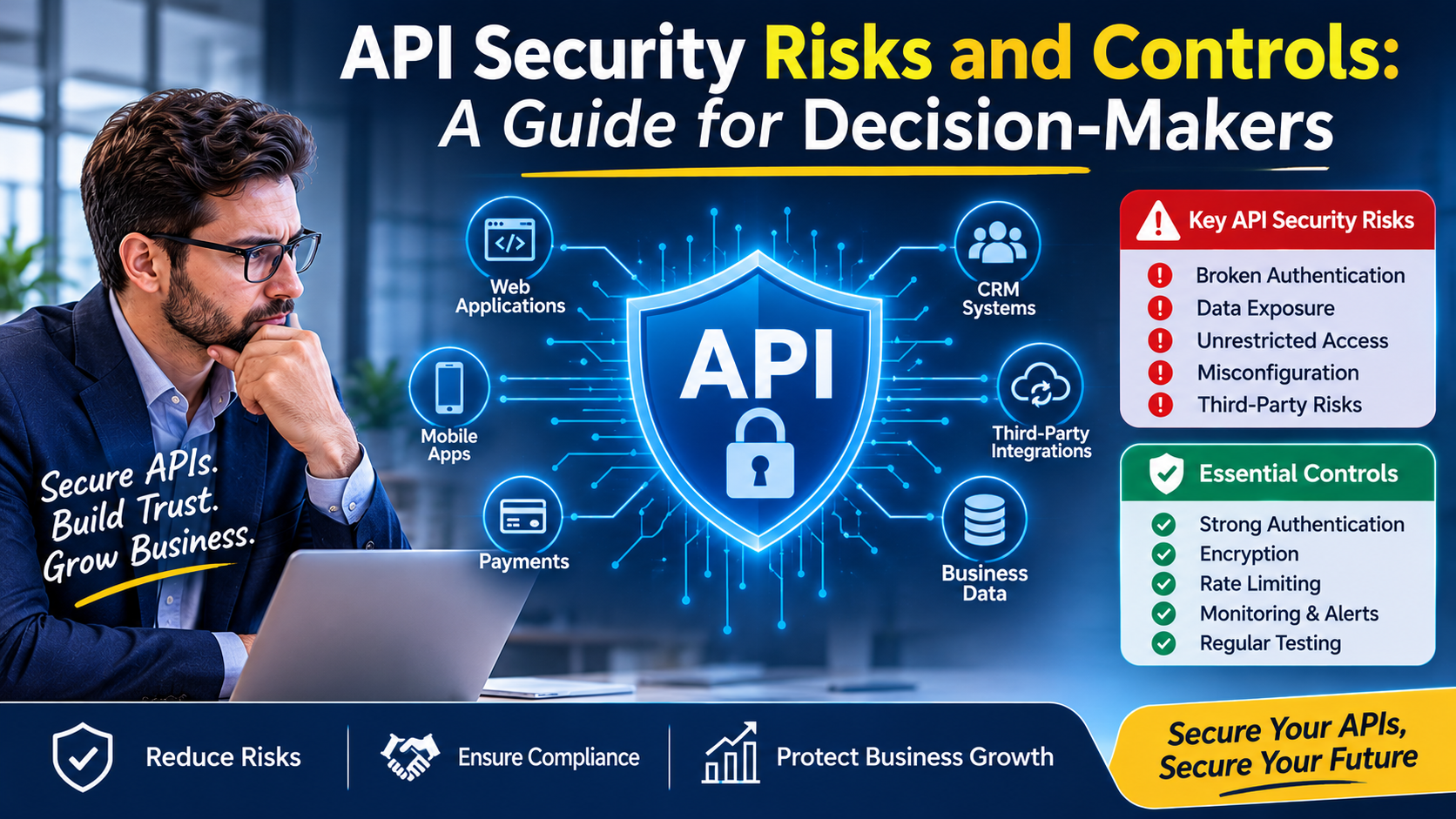
APIs (Application Programming Interfaces) play an important role in modern business applications. They allow websites, mobile apps, payment platforms, databases, and other software systems to communicate and exchange information. From processing online payments to managing customer accounts, APIs help businesses connect their digital operations and deliver better services.
However, every API connection can also introduce security risks.
An API with weak authentication, incorrect access permissions, or poor data protection can expose sensitive business information. Attackers may exploit these weaknesses to access customer records, manipulate transactions, disrupt services, or misuse business functionality.
For decision-makers, API security should not be treated as only a technical responsibility. It is a business priority that affects customer trust, operational stability, compliance, and long-term growth.
This guide explores the major API security risks, the controls businesses should implement, and how decision-makers can build a practical API security strategy.
Key Takeaways
- APIs can expose sensitive business and customer information when security controls are weak.
- Authentication verifies identity, while authorization determines what an authenticated user can access.
- Rate limiting, encryption, input validation, and monitoring help reduce common API security risks.
- Third-party integrations should be reviewed because external services can introduce vulnerabilities.
- API security should be included throughout the development lifecycle, from planning and design to deployment and maintenance.
- Decision-makers should prioritize API security based on business impact, data sensitivity, and potential exposure.
1. Why API Security Matters to Businesses
Businesses increasingly depend on APIs to connect applications and automate everyday operations. An e-commerce website may use APIs for payment processing, order management, customer accounts, and shipping updates. A healthcare platform may use them to exchange information between patient portals and internal systems. A financial application may rely on APIs to connect banking services and payment providers.
These integrations make business processes faster and more efficient, but they also increase the number of systems that can access important information.
Consider an online shopping platform. Customers log in to view their orders, update their profiles, and complete payments. If the API does not properly verify whether a customer owns a particular order, someone could potentially change an order ID and access another customer's information.
The API may be functioning correctly from a technical perspective, but its security controls are not doing their job.
The Business Impact of Weak API Security
Poor API security can affect a business in several ways:
Data exposure: Customer details, employee records, financial information, and internal business data may become accessible to unauthorized users.
Financial losses: Attackers may abuse payment APIs, create fraudulent transactions, or repeatedly trigger paid services.
Operational disruption: Excessive API requests or malicious activity can slow down applications and interrupt important business services.
Compliance concerns: Organizations that handle personal or regulated information may face legal, contractual, and regulatory consequences following a data breach.
Loss of customer trust: Customers expect businesses to protect their information. A security incident can damage customer confidence and business reputation.
For decision-makers, the important question is not simply whether an API works. It is whether the business understands what the API can access, who can use it, and what could happen if it is misused.
2. Major API Security Risks Decision-Makers Should Understand
The OWASP API Security Top 10 provides a useful framework for understanding common API vulnerabilities. Its 2023 edition highlights risks involving authorization, authentication, resource consumption, business-flow abuse, security misconfiguration, API inventory management, and third-party API consumption.
Here are the major risks businesses should understand.
2.1 Broken Authentication
Authentication verifies the identity of a user, application, or service making an API request.
Weak authentication can allow attackers to access APIs through stolen credentials, compromised tokens, or poorly implemented login mechanisms.
For example, if an application uses access tokens that never expire or cannot be revoked, a stolen token may allow unauthorized access for an extended period.
Recommended controls:
- Use established authentication standards such as OAuth 2.0 and OpenID Connect where appropriate.
- Apply multi-factor authentication to sensitive administrative access.
- Set appropriate token expiration and revocation policies.
- Store API keys and secrets securely.
- Never expose private credentials in frontend code or public repositories.
- Review authentication mechanisms regularly.
Decision-makers should ensure that authentication policies are consistent across internal applications, customer-facing services, and third-party integrations.
2.2 Broken Object Level Authorization
Broken Object Level Authorization (BOLA) occurs when an API allows a user to access a resource that belongs to someone else.
Imagine a customer portal where users can view their orders through an endpoint such as:
/api/orders/1001
If a user changes the order number to 1002 and the API returns another customer's order without checking ownership, the application has an authorization weakness.
This issue can expose customer records, invoices, account information, and other sensitive data.
Recommended controls:
- Verify ownership or access permissions for every requested object.
- Apply authorization checks on the server side.
- Do not rely on hidden buttons or frontend restrictions.
- Test APIs using different user accounts.
- Review access rules whenever new endpoints or user roles are introduced.
A valid login does not automatically mean a user should be able to access every record in the system.
2.3 Broken Function Level Authorization
Function-level authorization determines which actions a user is allowed to perform.
For example, a regular employee may be allowed to view reports but should not have permission to delete user accounts, change system settings, or access administrative functions.
If an API allows a regular user to call administrative endpoints, attackers may gain access to operations beyond their assigned permissions.
Recommended controls:
- Define clear user roles and permissions.
- Apply authorization checks to every sensitive endpoint.
- Separate administrative functions from regular user operations.
- Test access restrictions for different roles.
- Review permissions when employees change responsibilities.
Businesses should ensure that access is based on actual job responsibilities rather than convenience.
2.4 Excessive Data Exposure and Mass Assignment
An API may return more information than an application actually needs. It may also allow users to modify fields they should not control.
For example, a customer profile API might return internal account notes, administrative flags, or other sensitive fields even though the user only needs to see their name and email address.
Mass assignment can create another problem. If an API accepts unrestricted updates, a user might attempt to modify fields such as account status, permissions, or user roles.
Recommended controls:
- Return only the data required for each operation.
- Use explicit request and response schemas.
- Allow updates only to approved fields.
- Validate incoming data on the server.
- Avoid exposing internal properties through public API responses.
Data access should be limited at the field level, not just at the endpoint level.
2.5 Unrestricted Resource Consumption
APIs use resources such as processing power, memory, network bandwidth, and storage. Some requests may also trigger paid operations such as sending SMS messages, emails, or performing external verification.
Without proper limits, attackers or automated bots can send excessive requests, increase operational costs, or disrupt services.
Recommended controls:
- Apply rate limits based on users, API keys, or other appropriate identifiers.
- Set request-size and pagination limits.
- Use quotas for expensive operations.
- Monitor unusual traffic patterns.
- Apply caching where appropriate.
- Introduce additional verification for sensitive business actions.
Rate limiting should reflect actual business usage. A payment API, for example, may need different limits from a public product catalog API.
2.6 Unrestricted Access to Sensitive Business Flows
Some API risks are not caused by traditional software vulnerabilities. They arise when legitimate business functionality can be abused at scale.
For example, an API that supports account registration, discount redemption, ticket booking, or promotional offers may be repeatedly used by automated bots.
The API may function correctly, but the business process can still be exploited.
Recommended controls:
- Identify business operations that could be abused through automation.
- Apply transaction limits and usage policies.
- Introduce bot detection or additional verification where necessary.
- Monitor repeated or unusual activity.
- Review business rules for promotions, registrations, and purchases.
Security planning should consider how a feature could be misused, not just whether the code works correctly.
2.7 Server-Side Request Forgery (SSRF)
Server-Side Request Forgery occurs when an application is tricked into making requests to unexpected destinations using information supplied by a user.
For example, an API that fetches images or documents from user-provided URLs may be abused to access internal services if the destination is not properly validated.
Recommended controls:
- Validate and restrict allowed destination URLs.
- Block access to internal and sensitive network ranges where appropriate.
- Use outbound network restrictions.
- Avoid blindly trusting user-provided URLs.
- Monitor unexpected outbound requests.
This is particularly important for applications that process webhooks, import external resources, or communicate with third-party services.
2.8 Security Misconfiguration
An API may contain security weaknesses because of incorrect settings rather than vulnerable application code.
Examples include:
- Debug endpoints exposed in production.
- Unnecessary HTTP methods enabled.
- Overly permissive cross-origin settings.
- Default credentials left unchanged.
- Detailed error messages revealing internal information.
- Outdated software or insecure server configurations.
Recommended controls:
- Establish secure configuration standards.
- Disable unnecessary services and endpoints.
- Keep software dependencies and infrastructure updated.
- Review production settings before deployment.
- Perform regular configuration assessments.
Secure configuration should be part of the deployment process rather than an activity performed only after an incident.
2.9 Improper API Inventory Management
Businesses may operate more APIs than they realize. Older versions, forgotten endpoints, testing environments, and undocumented integrations can remain accessible even after the original project is completed.
An organization cannot properly protect an API it does not know exists.
Recommended controls:
- Maintain a centralized API inventory.
- Document API owners, purposes, data access, and environments.
- Track active and deprecated versions.
- Remove unused endpoints.
- Review public and internal API exposure regularly.
API inventory management helps security teams understand the complete attack surface.
2.10 Unsafe Consumption of Third-Party APIs
Businesses often depend on external APIs for payments, shipping, analytics, communication, and other services.
However, an external API should not automatically be trusted simply because it belongs to a known provider.
If a business accepts third-party responses without proper validation, unexpected or malicious data may affect its own application.
Recommended controls:
- Validate data received from external services.
- Use secure connections.
- Review provider security practices.
- Limit the permissions granted to integrations.
- Monitor third-party API failures and unusual responses.
- Maintain a plan for service outages or compromised integrations.
Third-party integrations should be included in the organization's overall security strategy.
3. Essential API Security Controls Every Business Should Prioritize
Understanding the risks is only the first step. Businesses need practical controls that reduce the likelihood and impact of API-related incidents.
The following controls provide a strong foundation.
3.1 Strong Authentication and Authorization
Every API should have a clear process for verifying the identity of the requester and determining what that requester can access.
Authentication and authorization should work together.
A user may successfully log in, but the API must still check whether that user has permission to view a specific record or perform a particular action.
Businesses should prioritize:
- Secure identity and access management.
- Role-based or attribute-based access controls where appropriate.
- Server-side permission checks.
- Token expiration and revocation.
- Regular access reviews.
3.2 Encryption in Transit and at Rest
Sensitive information should be protected while moving between systems and while stored.
Use HTTPS with properly configured TLS to protect API traffic. Sensitive stored information should also be encrypted using suitable encryption mechanisms and securely managed keys.
Encryption does not replace access controls, but it helps reduce the risk of information exposure if traffic or storage is compromised.
3.3 Rate Limiting and Traffic Management
Rate limiting helps prevent excessive API requests from overwhelming systems or increasing operational costs.
Businesses should define:
- Request limits for different API operations.
- Quotas for expensive services.
- Maximum request and payload sizes.
- Appropriate timeout settings.
- Monitoring and alerts for unusual traffic.
An API gateway can help centralize traffic management and apply consistent policies across multiple services.
3.4 Input Validation and Schema Enforcement
Every API request should be treated as untrusted input, even when it comes from an authenticated user.
Validation should check:
- Data types and formats.
- Required fields.
- Allowed values.
- Input lengths.
- Unexpected or unsupported properties.
- File types and upload sizes, where relevant.
Schema validation can help ensure that incoming requests follow the expected structure.
3.5 Logging, Monitoring, and Alerting
Businesses need visibility into how their APIs are being used.
Useful monitoring can identify:
- Repeated authentication failures.
- Unusual request volumes.
- Unexpected access to sensitive resources.
- Suspicious administrative actions.
- Repeated errors.
- Changes in traffic patterns.
Logs should include enough information to support investigation without unnecessarily storing passwords, access tokens, or sensitive personal data.
Monitoring should also have a response process. An alert is useful only when someone is responsible for reviewing and acting on it.
3.6 Regular API Security Testing
Security testing should happen throughout the API lifecycle.
A practical testing program may include:
- Static application security testing.
- Dynamic application security testing.
- Dependency and vulnerability scanning.
- API-specific authorization testing.
- Penetration testing.
- Configuration reviews.
Testing should cover different user roles and realistic business scenarios. Automated scanners can identify many issues, but manual testing remains important for complex authorization and business-logic weaknesses.
4. How Decision-Makers Should Prioritize API Security Investments
Not every API carries the same level of risk. A public API that displays general product information may have different security requirements from an API that processes payments or provides access to customer records.
Decision-makers should prioritize controls based on business impact and exposure.
Step 1: Identify Critical APIs
Start by listing APIs that support important business operations.
Examples include:
- Payment processing.
- Customer account management.
- Employee and HR systems.
- Financial reporting.
- Customer databases.
- Partner integrations.
- Administrative operations.
Identify which APIs are publicly accessible, internally accessible, or restricted to specific partners.
Step 2: Understand the Data Each API Handles
Classify the information processed by each API.
| Data Type | Example | Security Priority |
|---|---|---|
| Public information | Product descriptions | Standard protection |
| Business information | Internal reports | Restricted access |
| Customer information | Names and contact details | Strong access controls |
| Financial information | Payment and transaction records | High protection |
| Authentication data | Tokens and credentials | Strict protection |
The classification should reflect the organization's legal, contractual, and operational obligations.
Step 3: Evaluate Business Impact
For each API, ask:
- What happens if unauthorized users access it?
- Could someone modify or delete important records?
- Could the API be abused to generate unexpected costs?
- Would downtime interrupt customer operations?
- Does the API connect to a critical third-party service?
This helps leadership understand where security investment can reduce the greatest business risk.
Step 4: Assign Ownership
Every important API should have a responsible owner.
Ownership should cover:
- Business purpose.
- Technical maintenance.
- Security requirements.
- Access approvals.
- Vulnerability remediation.
- Incident response.
Without clear ownership, outdated endpoints and unresolved vulnerabilities can remain unnoticed.
Step 5: Build a Practical Improvement Roadmap
Avoid trying to solve every API security issue at once.
Start with high-impact areas such as authentication, authorization, sensitive data exposure, and API inventory. Then expand into traffic management, monitoring, testing, and third-party risk management.
A phased approach makes improvements easier to manage and measure.
5. API Security at Different Stages of the Development Lifecycle
API security should not be added only after an application is ready for release. It should be considered at every stage.
| Lifecycle Stage | Security Focus |
|---|---|
| Planning | Identify sensitive data, business risks, and access requirements |
| Design | Define authentication, authorization, and API boundaries |
| Development | Apply secure coding, validation, and error handling |
| Testing | Check permissions, vulnerabilities, and unusual usage scenarios |
| Deployment | Review configuration, secrets, and production access |
| Monitoring | Track API activity, alerts, and suspicious behavior |
| Maintenance | Update dependencies, review access, and remove unused endpoints |
The National Institute of Standards and Technology (NIST) provides guidance for protecting APIs across development and runtime stages. Its API protection guidance emphasizes identifying risks throughout the API lifecycle and applying appropriate controls based on organizational requirements.
This supports an important principle: API security should be a continuous process, not a one-time checklist.
6. Common API Security Mistakes Businesses Should Avoid
Even organizations that invest in security tools can leave important gaps.
Here are some common mistakes to watch for.
Relying only on authentication: A user being logged in does not mean they should have access to every resource or function.
Trusting frontend restrictions: Hiding a button does not prevent someone from calling the underlying API directly.
Exposing sensitive information: Returning unnecessary fields increases the impact of unauthorized access.
Ignoring older API versions: Deprecated endpoints may continue to expose data or functionality if they are not properly retired.
Using permanent API keys: Long-lived credentials without rotation or revocation controls increase the consequences of a leak.
Skipping third-party API reviews: External integrations can introduce security and availability risks.
Treating security testing as a one-time task: APIs change as applications evolve, so security checks must be repeated.
Collecting too much sensitive information in logs: Logs should support investigation without creating another source of data exposure.
Avoiding these mistakes requires consistent development practices, clear ownership, and regular reviews.
7. Measuring the Effectiveness of an API Security Program
Security improvements should be measurable. Decision-makers need indicators that show whether the organization's API security practices are improving.
Useful metrics include:
API inventory coverage: Percentage of known APIs documented and assigned an owner.
Authorization test coverage: Percentage of critical endpoints tested for access-control weaknesses.
Vulnerability remediation time: Time taken to resolve identified security issues.
Unmanaged API count: Number of unknown, outdated, or unapproved endpoints discovered.
Authentication failure trends: Changes in repeated or unusual failed login attempts.
Rate-limit effectiveness: Frequency and impact of excessive request activity.
Third-party review coverage: Percentage of critical integrations assessed for security risks.
These metrics should be reviewed regularly and connected to business priorities. A growing number of APIs, for example, should trigger a review of inventory coverage and ownership.
8. A Practical 90-Day API Security Improvement Plan
Businesses that do not have a structured API security program can start with a focused 90-day plan.
Days 1–30: Discover and Assess
- Create an inventory of known APIs.
- Identify API owners and business purposes.
- Classify sensitive data handled by each API.
- Identify public, internal, and third-party endpoints.
- Review existing authentication and authorization practices.
- Identify high-risk and outdated endpoints.
Goal: Understand the current API environment and identify the most important risks.
Days 31–60: Strengthen Core Controls
- Fix critical authentication and authorization weaknesses.
- Introduce rate limits for exposed endpoints.
- Improve input validation and data filtering.
- Review API keys, tokens, and secrets.
- Secure production configurations.
- Establish logging and monitoring for critical APIs.
Goal: Reduce the most significant security weaknesses and improve visibility.
Days 61–90: Test and Establish Ongoing Governance
- Conduct API security testing.
- Review third-party integrations.
- Create a vulnerability remediation process.
- Establish API documentation and versioning standards.
- Assign ongoing security responsibilities.
- Define metrics and a regular review schedule.
Goal: Move from individual security fixes to a repeatable API security program.
The timeline can be adjusted depending on the size, complexity, and risk profile of the organization.
9. Questions Business Leaders Should Ask Their Technical Teams
Decision-makers do not need to understand every technical detail of API security. However, they should ask questions that reveal whether important risks are being managed.
- Do we have a complete inventory of our APIs?
- Which APIs handle sensitive customer or business information?
- How do we verify that users can access only the records they are authorized to see?
- Are administrative functions protected by separate permissions?
- How do we detect excessive or suspicious API traffic?
- When were our critical APIs last security tested?
- How do we evaluate the security of third-party integrations?
- Who is responsible for fixing API vulnerabilities?
- What happens when an API key or access token is compromised?
- How quickly can we disable an exposed or vulnerable endpoint?
The answers can help leadership identify gaps, assign responsibility, and make informed investment decisions.
Frequently Asked Questions
1. What is API security?
API security refers to the practices and controls used to protect APIs from unauthorized access, data exposure, misuse, and attacks. It includes authentication, authorization, encryption, input validation, monitoring, and security testing.
2. Why is API security important for small and medium-sized businesses?
SMBs often depend on APIs for payments, customer management, cloud applications, and third-party integrations. A vulnerable API can expose business data, interrupt services, or create unexpected costs. Strong API security helps protect operations and customer trust.
3. What is the difference between API authentication and authorization?
Authentication verifies who is making a request. Authorization determines what that user or application is allowed to access or do. Both are necessary to protect sensitive API operations.
4. What are the most common API security risks?
Common risks include broken object-level authorization, broken authentication, excessive data exposure, unrestricted resource consumption, security misconfiguration, improper API inventory management, and unsafe consumption of third-party APIs.
5. How can businesses protect APIs from unauthorized access?
Businesses should use strong authentication, server-side authorization checks, secure token management, encryption, rate limiting, and regular security testing. Permissions should be checked for every sensitive operation and resource.
6. How often should API security testing be performed?
API security should be tested during development, before major releases, and regularly after deployment. Additional testing is important whenever APIs, permissions, integrations, or infrastructure change.
7. Can third-party APIs create security risks?
Yes. External APIs can introduce risks if their responses are trusted without validation, their credentials are poorly managed, or their security practices are inadequate. Businesses should assess critical providers and restrict the access granted to integrations.
8. What should decision-makers prioritize first?
Start with an API inventory, identify sensitive data, review authentication and authorization, and address critical vulnerabilities. Then strengthen monitoring, rate limiting, third-party reviews, and ongoing security governance.
Work with eSparks IT Solutions
Planning a project around this? We help businesses across the USA,UK, Canada, Australia and the GCC ship it. See how we work with clients in the USA. Explore our Programming services and portfolio, estimate your project cost, or book a free call.
Related Development Services
→ Backend & API Development → Web Development Services → [Hire Dedicated Developers] (https://www.esparksit.com/locations/hire-dedicated-developers-uk) → Estimate your project cost
Comments
Join the discussionNo comments yet. Be the first to comment.