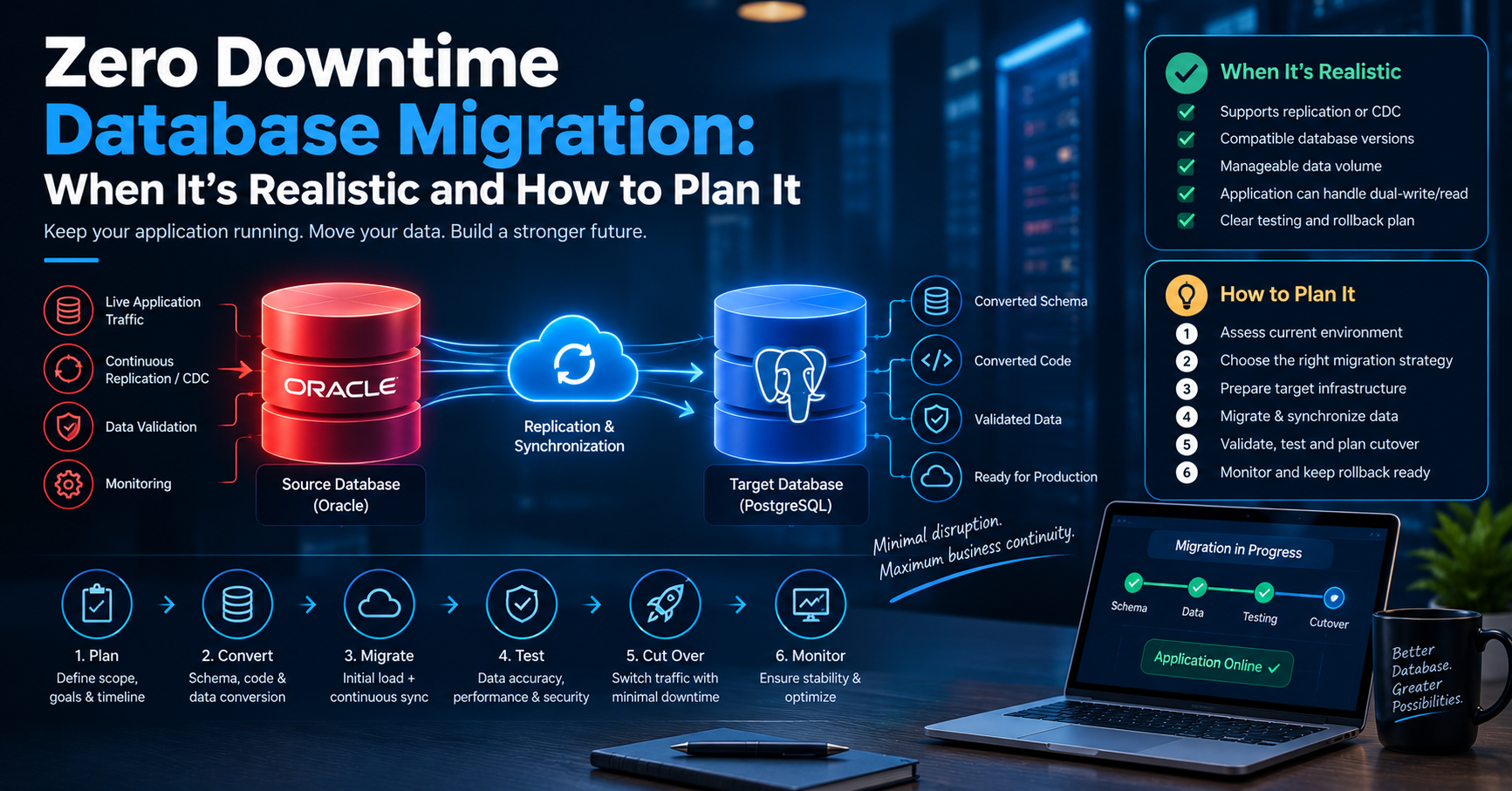
Oracle to PostgreSQL Migration Tools: Schema, Code Conversion, and Downtime Control
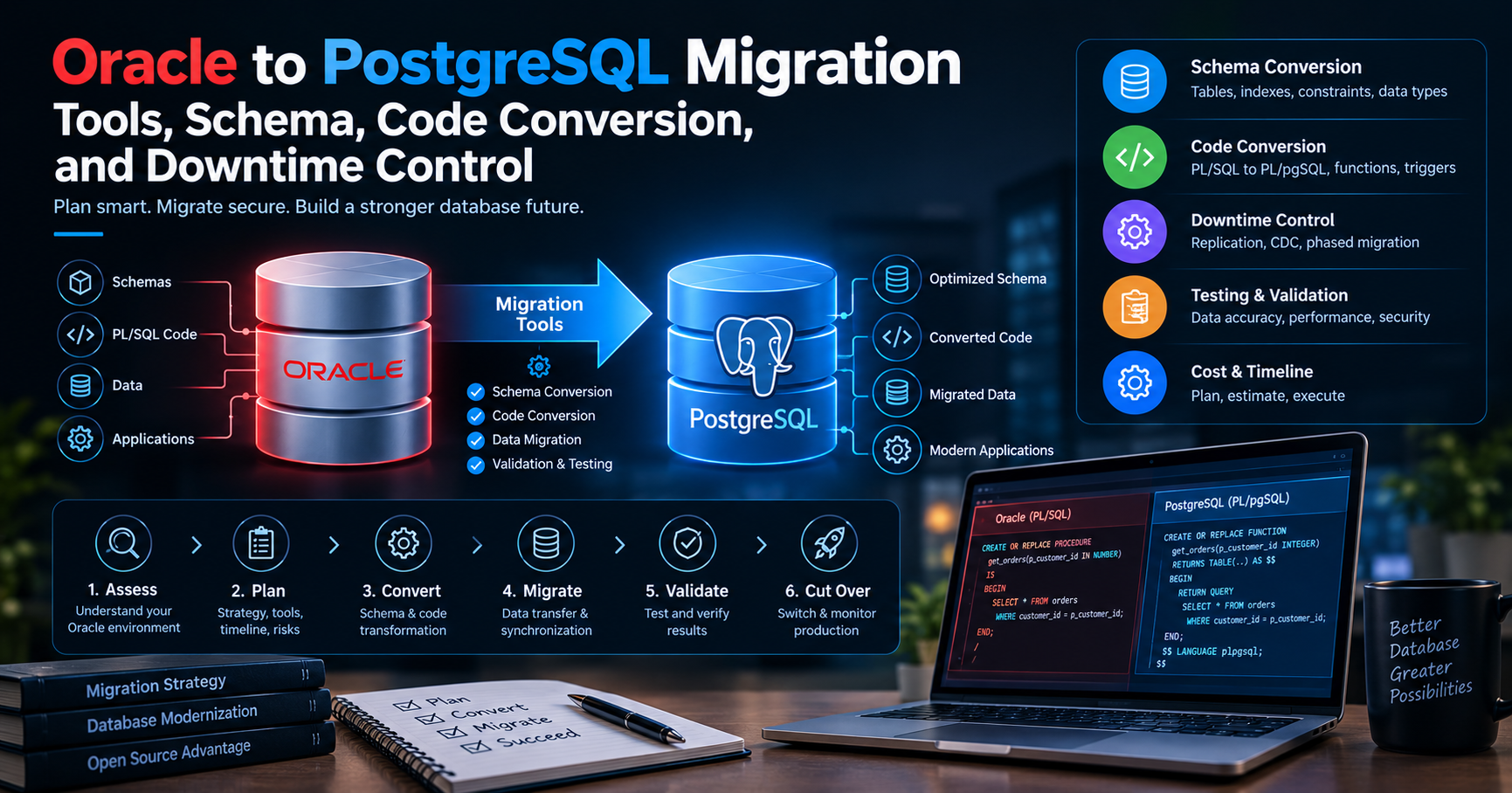
Migrating an enterprise database from Oracle to PostgreSQL is not simply a matter of exporting data from one database and importing it into another. Oracle and PostgreSQL have different SQL syntax, data types, procedural languages, indexing approaches, database features, and administration models.
For organizations planning an Oracle to PostgreSQL migration, the biggest challenges often appear in three areas: converting the database schema, rewriting Oracle-specific code, and controlling downtime during the final transition.
The right migration tools can automate many repetitive tasks, but tools alone do not guarantee a successful migration. A reliable project combines automated conversion with manual code review, data validation, application testing, performance optimization, and a carefully planned cutover.
Key Takeaways
- Oracle to PostgreSQL migration requires schema, code, data, and application-level planning.
- Automated migration tools can reduce manual conversion effort.
- Oracle-specific PL/SQL code may require significant rewriting.
- Data types, sequences, packages, procedures, functions, triggers, and indexes need compatibility review.
- Downtime can be reduced by using continuous data synchronization or change-data-capture approaches.
- A proof of concept can expose compatibility problems before production migration.
- Testing should cover data accuracy, application behavior, performance, security, and integrations.
- The right migration strategy depends on database size, application complexity, and acceptable downtime.
Why Organizations Migrate from Oracle to PostgreSQL
Oracle remains a powerful enterprise database platform, but organizations may consider PostgreSQL for several reasons.
One major consideration is licensing and infrastructure cost. PostgreSQL is open source, which can provide organizations with greater flexibility around database licensing.
PostgreSQL can also fit well into modern cloud-native, containerized, and open-source technology environments.
Organizations may also migrate because they want to:
- Reduce database licensing expenses
- Modernize legacy applications
- Adopt open-source technologies
- Improve cloud flexibility
- Simplify database infrastructure
- Reduce vendor dependency
- Standardize on PostgreSQL across applications
However, cost savings should not be the only factor. Migration itself requires engineering, testing, infrastructure, and operational investment.
Why Oracle to PostgreSQL Migration Is Challenging
Oracle and PostgreSQL share many relational database concepts, but their implementations are different.
Migration can become complicated when an Oracle database contains:
- PL/SQL packages
- Complex stored procedures
- Triggers
- Materialized views
- Sequences
- Oracle-specific data types
- Database links
- Custom functions
- Advanced indexing
- Partitioning
- Scheduled jobs
- Application-specific SQL
- Large volumes of transactional data
The more Oracle-specific functionality an application uses, the more conversion work may be required.
The Three Main Migration Areas
A successful Oracle to PostgreSQL migration usually involves three major technical workstreams.
1. Schema Conversion
The database structure needs to be recreated in PostgreSQL.
2. Code Conversion
Oracle-specific SQL and PL/SQL logic needs to be converted or redesigned.
3. Data Migration
Production data needs to be transferred accurately while meeting the required downtime target.
These three areas are closely connected.
A schema may migrate successfully, but application code can still fail because it depends on Oracle-specific behavior. Similarly, the application may work correctly while data migration takes too long for the planned maintenance window.
Oracle to PostgreSQL Migration Tools
Different tools can be used for different stages of the migration.
Some tools focus on schema and code conversion, while others help with bulk data transfer, replication, monitoring, or validation.
A typical toolset may include:
- Schema conversion tools
- SQL and PL/SQL conversion tools
- Bulk data migration utilities
- Change-data-capture tools
- Database replication solutions
- Data comparison tools
- Performance monitoring tools
- Application testing tools
The best approach is not necessarily to choose one tool for everything.
A migration architecture may use one tool for initial schema conversion, another for continuous data synchronization, and automated scripts for validation.
Schema Conversion: What Needs to Change?
Schema conversion is the first major technical step.
The migration team should review:
- Tables
- Columns
- Data types
- Primary keys
- Foreign keys
- Constraints
- Indexes
- Sequences
- Views
- Materialized views
- Triggers
- Functions
- Procedures
Data Type Mapping
Oracle and PostgreSQL use different data type systems.
For example:
| Oracle | PostgreSQL |
|---|---|
NUMBER |
NUMERIC, INTEGER, or BIGINT depending on usage |
VARCHAR2 |
VARCHAR |
CHAR |
CHAR |
DATE |
TIMESTAMP or DATE depending on requirements |
CLOB |
TEXT |
BLOB |
BYTEA |
RAW |
BYTEA |
TIMESTAMP |
TIMESTAMP |
XMLTYPE |
PostgreSQL-compatible XML or another suitable representation |
These mappings should not be applied blindly.
For example, converting every Oracle NUMBER column to NUMERIC may work technically but may not be the best choice for application performance or storage.
The actual business and application requirements should determine the final PostgreSQL type.
Sequence and Identity Conversion
Oracle applications often rely on sequences for generating unique identifiers.
PostgreSQL also supports sequences, as well as identity columns.
During migration, verify:
- Sequence values
- Starting values
- Increment settings
- Application references
- Primary key behavior
- Insert logic
Incorrect sequence handling can cause duplicate key errors after migration.
Converting PL/SQL to PostgreSQL
This is often one of the most challenging parts of the project.
Oracle applications may contain hundreds of lines of PL/SQL across:
- Procedures
- Functions
- Packages
- Triggers
- Exception-handling logic
PostgreSQL uses PL/pgSQL and has its own syntax and behavior.
Simple functions may be relatively easy to convert, while complex packages can require significant redesign.
A practical conversion process is:
Discover → Convert → Review → Test → Optimize
Automated tools can help produce an initial conversion, but developers should review the resulting code manually.
Oracle Packages Require Special Attention
Oracle packages are a major migration consideration because PostgreSQL does not provide an identical package model.
A package may contain:
- Public procedures
- Private procedures
- Functions
- Variables
- Constants
- Shared business logic
During migration, package functionality may need to be reorganized into PostgreSQL functions, procedures, schemas, tables, or application-level services.
This is not simply a syntax conversion task.
The goal should be to preserve the required business behavior rather than reproduce Oracle's internal structure exactly.
SQL Query Conversion
Applications may contain Oracle-specific SQL that does not work directly in PostgreSQL.
Examples include differences in:
- Date functions
- String functions
- Null handling
- Sequence usage
- Pagination
- Joins
- Conditional expressions
- Regular expressions
- Hierarchical queries
- Transaction behavior
Application code should therefore be scanned for Oracle-specific SQL before the final migration.
Application Dependencies Matter
The database is rarely isolated.
Applications may connect to Oracle through:
- JDBC
- ODBC
- .NET drivers
- ORM frameworks
- Reporting platforms
- ETL systems
- APIs
- Background jobs
- Business intelligence tools
After migration, these connections may need to be updated for PostgreSQL.
The team should create an application dependency inventory before beginning production migration.
Bulk Data Migration
For large databases, the initial data load can take significant time.
A typical process looks like:
- Prepare PostgreSQL.
- Convert and create the schema.
- Perform the initial data load.
- Validate the migrated data.
- Start synchronizing ongoing changes.
- Continue testing the application.
- Perform final synchronization.
- Switch production traffic.
The initial data load can happen before the final cutover, which helps reduce the amount of data that needs to move during the maintenance window.
Downtime Control
Downtime is one of the biggest concerns in enterprise database migration.
A basic approach is to stop the application, migrate the latest data, and then switch to PostgreSQL.
This can work for systems that tolerate longer maintenance windows.
For business-critical systems, however, a more advanced strategy may be required.
Offline Migration
The application is stopped while data is migrated.
Advantages:
- Simple architecture
- Easier to manage
- Lower synchronization complexity
Disadvantages:
- Longer downtime
- Larger cutover window
Online or Near-Zero-Downtime Migration
The source Oracle database continues operating while changes are synchronized to PostgreSQL.
The final cutover can then be reduced to a short maintenance window.
This approach is useful when applications cannot remain offline for extended periods.
Change Data Capture for Oracle Migration
Change Data Capture, or CDC, can help track changes made to the Oracle source after the initial data load.
The general architecture looks like this:
Oracle → Initial Load → PostgreSQL
while ongoing changes follow:
Oracle → CDC/Replication → PostgreSQL
Once the PostgreSQL database catches up with Oracle, the application can be switched to the new environment.
The exact implementation depends on the Oracle version, PostgreSQL environment, migration tooling, data volume, and business requirements.
How to Plan the Final Cutover
The cutover should be treated as a separate project phase rather than an afterthought.
A typical cutover plan includes:
Step 1: Freeze Application Changes
Avoid deploying unrelated application changes immediately before migration.
Step 2: Stop or Restrict Writes
Prevent new transactions from creating differences between Oracle and PostgreSQL.
Step 3: Complete Final Synchronization
Allow the remaining changes to reach PostgreSQL.
Step 4: Validate
Check critical tables, record counts, transactions, and application dependencies.
Step 5: Switch Application Connections
Update the application to use PostgreSQL.
Step 6: Monitor
Watch application errors, database performance, queries, and business workflows.
Step 7: Maintain Rollback Readiness
Keep the Oracle environment available until the migration has been fully validated.
Data Validation After Migration
A successful migration should not be measured only by whether the database starts.
Validation should compare:
- Table counts
- Row counts
- Primary keys
- Foreign keys
- Important business records
- Numeric values
- Dates
- Null values
- Duplicate records
- Aggregated totals
For critical systems, automated comparison scripts can help identify differences quickly.
Business-level validation is also important.
For example, if an application tracks invoices, the team should verify that invoice totals and transaction counts remain consistent after migration.
Performance Testing
PostgreSQL may behave differently from Oracle even when the application produces the same results.
Performance testing should cover:
- Query response time
- Transaction throughput
- CPU utilization
- Memory usage
- Disk I/O
- Connection pooling
- Index performance
- Batch jobs
- Reporting queries
Indexes should be reviewed instead of simply copied from Oracle.
Queries that performed well in Oracle may require PostgreSQL-specific optimization.
Common Oracle to PostgreSQL Migration Risks
PL/SQL Compatibility
Complex PL/SQL code may require manual rewriting.
Data Type Differences
Incorrect mapping can lead to data loss or unexpected application behavior.
Application Dependencies
Hidden Oracle dependencies may remain inside application code or third-party integrations.
Performance Changes
Query execution plans can behave differently after migration.
Long Migration Windows
Large databases can take longer than expected to transfer and validate.
Data Synchronization Problems
Near-zero-downtime migrations require reliable change synchronization.
Incomplete Testing
A migration can appear successful while hidden business workflows still fail.
How to Reduce Migration Risk
A practical risk-reduction strategy includes:
1. Perform Discovery
Understand the Oracle environment and its dependencies.
2. Run a Compatibility Assessment
Identify Oracle-specific objects and code.
3. Build a Proof of Concept
Migrate a representative database or workload.
4. Automate Where Possible
Use tools for repetitive schema, code, and data conversion tasks.
5. Test Early
Do not wait until production migration to discover compatibility issues.
6. Perform a Migration Rehearsal
Measure actual migration duration and identify bottlenecks.
7. Define a Rollback Plan
Know exactly how to return to Oracle if required.
Estimating Migration Costs
Oracle to PostgreSQL migration cost depends on much more than database size.
Important cost factors include:
- Database size
- Number of schemas
- PL/SQL complexity
- Number of applications
- Application code changes
- Data transfer requirements
- CDC or replication requirements
- Testing effort
- Infrastructure
- Migration tools
- Security requirements
- Downtime requirements
- Post-migration support
A simple database with a few applications may require a relatively small migration effort.
A large enterprise database with complex PL/SQL, multiple integrations, and strict downtime requirements can require a much larger engineering investment.
Oracle to PostgreSQL Migration Timeline
A typical project can be divided into several phases:
| Migration Phase | Typical Duration |
|---|---|
| Discovery & Assessment | 1–3 weeks |
| Schema & Code Analysis | 2–4 weeks |
| Proof of Concept | 1–2 weeks |
| Conversion & Migration Development | 3–8 weeks |
| Application Updates | 2–8 weeks |
| Testing & Optimization | 2–6 weeks |
| Migration Rehearsal | 1–2 weeks |
| Production Cutover | Hours to several days |
| Post-Migration Monitoring | 1–2 weeks |
These are general planning ranges. Large or highly customized environments can require significantly more time.
Choosing the Right Migration Toolset
Instead of asking, “Which migration tool is best?”, organizations should ask:
Which tools fit our database, application, data volume, and downtime requirements?
Evaluate tools based on:
- Oracle version support
- PostgreSQL compatibility
- Schema conversion capabilities
- PL/SQL conversion support
- Data migration speed
- CDC capabilities
- Monitoring
- Error handling
- Data validation
- Automation
- Scalability
- Licensing cost
- Support
A combination of tools is often more practical than trying to force one product to handle every migration requirement.
A Practical Oracle to PostgreSQL Migration Workflow
A structured workflow can make the project easier to manage.
Phase 1: Discover
Inventory databases, applications, schemas, code, integrations, and dependencies.
Phase 2: Assess
Identify compatibility issues, technical risks, data volume, and downtime requirements.
Phase 3: Plan
Choose tools, migration strategy, testing approach, rollback plan, and project timeline.
Phase 4: Convert
Convert schema objects, SQL queries, PL/SQL, sequences, functions, triggers, and other required components.
Phase 5: Migrate
Perform the initial data migration and establish synchronization where required.
Phase 6: Validate
Verify data accuracy, application functionality, performance, security, and integrations.
Phase 7: Rehearse
Perform a complete migration rehearsal and measure the actual cutover duration.
Phase 8: Cut Over
Execute the production migration using a documented runbook.
Phase 9: Stabilize
Monitor PostgreSQL, resolve issues, optimize performance, and maintain rollback readiness.
Common Mistakes to Avoid
Treating Migration as Only a Data Problem
The application and database logic are equally important.
Assuming Automated Conversion Is Perfect
Migration tools can save time, but generated code still requires review and testing.
Ignoring Oracle Packages
Complex packages can contain critical business logic and should be assessed early.
Copying Every Index
PostgreSQL may require different indexing strategies based on query patterns.
Skipping Migration Rehearsals
A rehearsal provides valuable information about actual migration duration and potential bottlenecks.
Planning Downtime Too Late
Downtime requirements should influence the migration architecture from the beginning.
Decommissioning Oracle Immediately
Keep the original environment available until the new system has been properly validated and accepted.
Frequently Asked Questions
Can Oracle databases be migrated directly to PostgreSQL?
Yes, but the migration usually requires schema conversion, data transfer, code conversion, application updates, and testing.
Which Oracle objects require the most conversion effort?
Complex PL/SQL packages, procedures, functions, triggers, Oracle-specific SQL, and database-dependent application logic can require significant effort.
Can migration tools automatically convert PL/SQL?
Some tools can automate or assist with parts of PL/SQL conversion, but complex business logic generally requires manual review and testing.
How can Oracle to PostgreSQL migration downtime be reduced?
Initial data can be migrated before the final cutover, while CDC or replication can synchronize ongoing changes. This can significantly reduce the amount of work required during the final maintenance window.
How long does Oracle to PostgreSQL migration take?
Simple migrations may take several weeks, while complex enterprise migrations can take several months depending on database size, code complexity, applications, testing, and downtime requirements.
Is PostgreSQL a good alternative to Oracle?
PostgreSQL can be a strong alternative for many workloads, but suitability depends on application requirements, database features, performance expectations, operational capabilities, and migration objectives.
Work with eSparks IT Solutions
Planning a project around this? We help businesses across the USA,UK, Canada, Australia and the GCC ship it. See how we work with clients in the USA. Explore our Programming services and portfolio, estimate your project cost, or book a free call.
Related Development Services
→ Backend & API Development → Web Development Services → [Hire Dedicated Developers] (https://www.esparksit.com/locations/hire-dedicated-developers-uk) → Estimate your project cost
Comments
Join the discussionNo comments yet. Be the first to comment.